Every enterprise relies on a massive web of business rules to govern its day-to-day operations. These include pricing tiers, compliance thresholds, fraud signatures, and automated routing logic. However, our experience from 480+ demos* with clients points to a persistent challenge: operational bottlenecks almost always stem from manual translation, complex logical scripting, and blind test-data preparation.
When business logic is buried inside legacy spreadsheets, trapped in black-box code, or manually written into brittle stored procedures, innovation stalls. The DecisionRules AI Assistant was built to eliminate these exact friction points by serving as a context-aware, real-time partner directly within your web workspace window.
* Based on internal analysis of demo calls conducted with customers and prospects.
The Core Pillars of AI-Driven Value
By working closely with our clients and understanding the most frequent hurdles they face, we designed the DecisionRules AI Assistant to directly address the highest-volume demands in decision automation. The Assistant delivers on-demand intelligence right inside your active workspace window. Internal benchmarks across three analyst experience levels confirm an average 60% reduction in rule authoring time and a 3x increase in daily productivity for risk and business analysts
1. Accelerating Rule Generation (From Concept to Matrix in Seconds)
The slow part of building a rule is not deciding what it should do. It is turning that decision into a structured Decision Table or a set of routing criteria, row by row. Rule generation is the single most requested capability from teams trying to speed up their workflow, because translating a fluid business policy into a clean data table usually means pulling in a software engineer.

Rule Generation
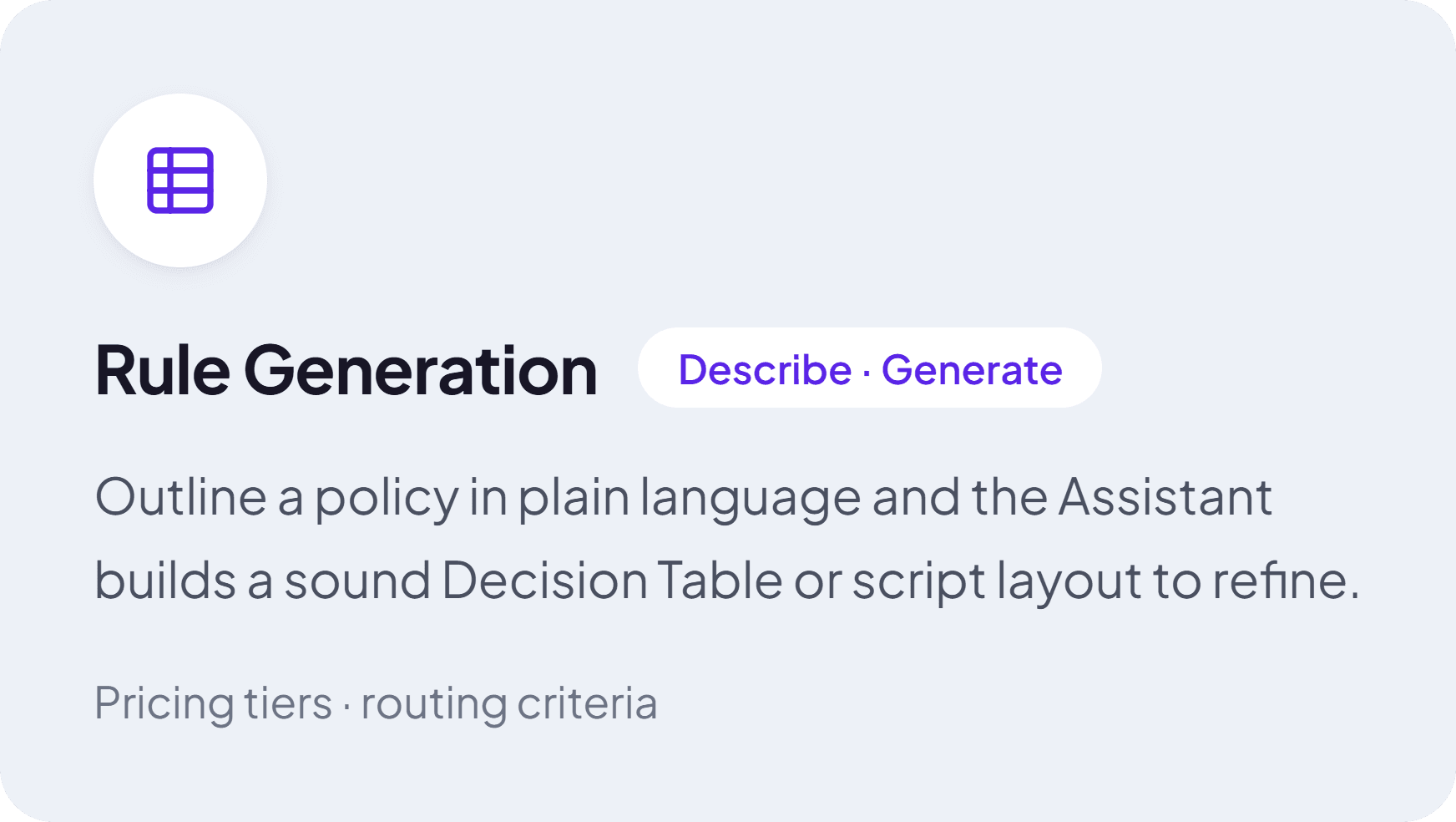
Outline a policy in plain language and the Assistant builds a sound Decision Table or script layout to refine.
Pricing tiers · routing criteria
The Assistant removes that handoff. Outline the policy in plain language, or paste in a description of the logic, and it interprets what you wrote and builds a structurally sound table or script layout right in your active window. You start from intent and refine from there, instead of entering every condition by hand.
2. Streamlining Complex Expressions with the Function Builder
As logic scales, the formulas compound. Multi-conditional blocks, dynamic date math, and array operations like nested loops are where people lose time, hunting through documentation or guessing at the syntax for functions like append or collect.

Function Builder
Select a cell and ask for the expression. It reads the context, writes a clean formula, and explains existing logic.
Nested conditions · date calculations
The Function Builder turns that into a question instead of a search. Select a cell or node and ask the Assistant to write the expression. It reads the surrounding context, proposes a clean formula, and can explain logic that is already there. In practice it works like a pair-programmer who already knows your rule: you describe the result you want, and it handles the syntax.
3. Automated Test-Data Generation and "What-If" Confidence
Verifying a complex rule usually means fabricating mock JSON payloads by hand to trigger specific edge cases. It is slow, it is easy to miss a path, and the gaps tend to surface as unexpected behavior in production.

Test‑Data Generation
Point the Assistant at your input and output schemas and it builds the test matrices for you. Get broad coverage for untested logic paths, or the exact combination that makes a rule fail, without typing a single payload.
Edge cases · coverage gaps
The Assistant reads your input and output schemas directly and builds the test matrices for you. Whether you need random datasets to stress-test parallel execution limits, coverage for the logic paths nobody has exercised yet, or the exact combination that makes a rule fail, you get broad test coverage without typing a single payload.
The Workspace Governance and Architecture Matrix
Beyond day-to-day authoring, the AI Assistant provides a complete suite of management tools to handle inline documentation, validation, and project navigation. Learn more on our Rule Summary Page.
| Operational Objective | Legacy Friction Point | AI Assistant Solution |
|---|---|---|
| Auditable Documentation | Business and compliance teams often cannot read the underlying rule code, making it difficult to verify if policies are being followed correctly. | Automated, natural-language generation of summaries to explain exact calculation paths to non-technical stakeholders. |
| Real-Time Guidance | Missing documentation or hard-to-find function operators slow down user onboarding and speed-to-market. | Contextual support inside the designer panel via our Built-In AI Expert, matching user queries to active workspace elements. |
| Optimization Review | Overlapping logic, human data-entry errors, and redundant conditions clutter tables over time. | Real-time analysis of rule layouts to identify conflicts, redundancies, or inefficiencies before deployment. |
Secure Model Orchestration for IT Decision Makers
Technical gatekeepers are rightfully focused on data boundaries, intellectual property protection, and compliance privacy. The DecisionRules AI Assistant integrates with Google Gemini and is available on cloud plans out of the box.
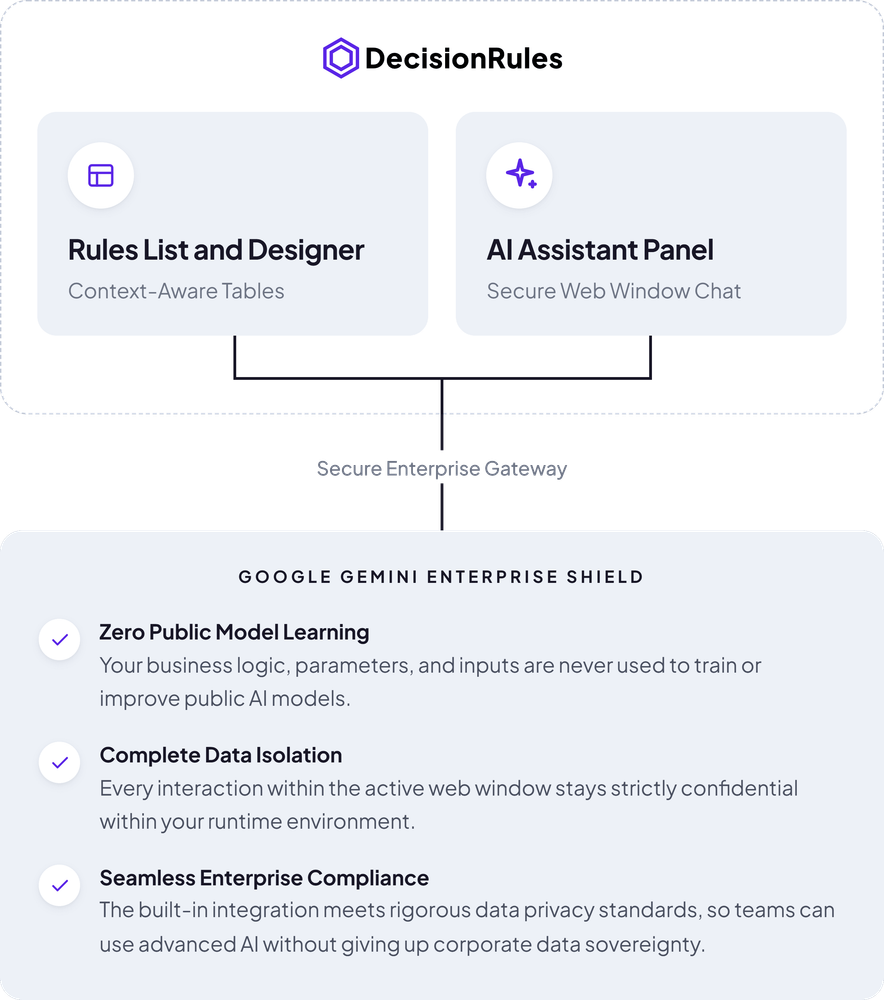
The AI Assistant runs on Google Gemini under enterprise privacy terms. Your rules context and payloads stay isolated and never train public models.
This dedicated architecture ensures that environment managers do not have to worry about data leakage or complex API orchestration. By leveraging Gemini under strict enterprise privacy terms, your operational payloads and rules context are entirely isolated. Your data is handled with maximum security:
For organizations with stricter data governance requirements, a self-managed deployment allows teams to connect their own credentials, keeping all AI interactions within their own infrastructure.
Maximizing Operational Velocity Safely
Speed and control are often treated as a trade-off in enterprise software. The DecisionRules AI Assistant is built on the premise that they do not have to be. By embedding context-aware automation directly into the workspace, the Assistant removes the manual steps that slow teams down without removing the oversight that keeps decisions sound.
Business experts generate structured tables from plain language descriptions, engineers resolve syntax hurdles on demand, and risk teams stress-test rule logic without assembling test payloads by hand. Every one of these actions happens inside a governed, enterprise-ready environment where your business logic stays isolated, your data stays yours, and your team stays in control of every decision that goes live.

Ivan Peresta works at DecisionRules, where his role spans product analysis, professional services, and customer support. He is involved across the full lifecycle of product features, from early design and UX thinking to hands-on testing, documentation, and customer-facing delivery. His work bridges the gap between product development and the people who actually use it, whether that means helping a customer design their rule system or making sure a new feature ships with clear guidance and working examples.