DecisionRules
vs. IBM Operational Decision Manager (ODM)
DecisionRules and IBM Operational Decision Manager are both Business Rule Management Systems used to author, manage, and execute decision logic at enterprise scale. IBM ODM is a 30-year-old BRMS deeply integrated with the WebSphere stack, with strong DMN support, Complex Event Processing, and a deep IBM ecosystem footprint. DecisionRules is a cloud-native BRMS with a schema-first model, AI Assistant, native modern integrations, execution-level audit logging, SOC 2 and ISO 27001 certification, and three deployment options.
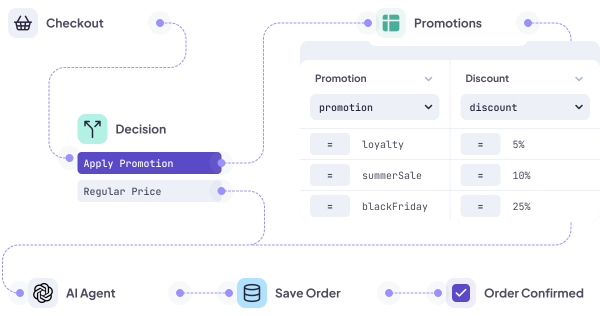
FACTUAL COMPARISON
What are the main differences between DecisionRules and IBM ODM?
Only things verified against both documentation sites. No guessing.
 IBM ODM
  DecisionRules
 Delivered as a managed service. Public Cloud runs as SaaS on AWS (US, EU, AU regions). Private Managed Cloud is a dedicated environment our team stands up in roughly five days. Self-Hosted runs as Docker or Kubernetes, including air-gapped. All three options share the same UI, APIs, and skill set. For cloud options, nothing to install, patch, or scale.
IBM ODM A multi-component stack — Decision Center for authoring, Decision Server / Rule Execution Server for runtime, Rule Designer (Eclipse plug-in), a rule repository database, and an application server underneath (WebSphere ND, Liberty, JBoss, WebLogic, or Tomcat). Available on-premises, on IBM Cloud, and on Certified Kubernetes. WebSphere administration and ODM internals are the skill set required for self-managed deployments.
DecisionRules Schema-first. Rule input and output are typed JSON schemas declared in the same browser environment as the rule. A field in the schema is immediately available as a column in a Decision Table or a branch in a Decision Tree. No separate object model, no manual verbalisation, no developer ticket to surface a new variable.
IBM ODM Four-layer model. A developer authors a Java Execution Object Model (XOM), wraps it in a Business Object Model (BOM), writes English verbalisations by hand, and only then can a business user assemble rules in Business Action Language (BAL) from the resulting dropdown. New fields require a developer to extend XOM, update BOM, re-verbalise, and republish.
DecisionRules Built-in AI Assistant generates entire Decision Tables from a natural-language prompt, writes function expressions for individual cells, generates test data, and explains existing rules in plain language. Internal benchmarks show 60% faster authoring.
IBM ODM Rule authoring through Decision Center and Rule Designer with rule analysis, decision modelling, and DVS testing. A built-in GenAI assistant that generates Decision Tables, BAL rules, or test data from natural-language prompts is not part of the ODM feature set. IBM's GenAI capabilities live in separate products outside ODM.
DecisionRules Native connectors for Apache Kafka (asynchronous solver), n8n, Zapier, Power Automate, an Excel Add-In for testing rules on real data, and a dedicated Power BI connector. Decision Flow also includes REST API Client nodes and DB Connectors for direct system access during evaluation.
IBM ODM REST and SOAP rule services, an extensive Decision Center REST API for CI/CD, and emitter support for IBM Business Automation Insights. Native connectors for n8n, Zapier, Power Automate, or a dedicated Power BI connector are not part of the platform — integration is typically built by your team on top of the REST services.
DecisionRules Every rule evaluation can be captured with input/output data, timestamps, rule ID, version, and correlation ID. The Business Intelligence API and Power BI connector export this data into your warehouse or dashboards. Filter by rule, version, solver key, tag, status code, or time window.
IBM ODM Rule Execution Server keeps execution statistics (count, average and maximum execution time per ruleset) viewable in the RES console. For richer per-decision tracing, IBM provides an emitter that streams execution events to the Business Automation Insights (BAI) module — a separate IBM Cloud Pak component.
DecisionRules Decision Flows, Decision Tables, and Lookup Tables together cover the patterns DMN expresses — hit policies, decision requirements, branching, aggregation. Strict DMN-standard notation and DMN file interchange aren't part of the platform.
IBM ODM Built-in decision modelling in Decision Center (since 8.10.5) derived from the DMN standard, plus rule logic editable as Decision Tables or BAL. Mature DMN support is one of ODM's real strengths, with a deep partner ecosystem (DecisionsFirst Modeler) for full DMN-first projects.
DecisionRules Apache Kafka integration handles event-driven decisioning — events arrive on a topic, DecisionRules evaluates each one, results go back on a topic. Stateful pattern detection across event streams (e.g. "three failed logins followed by a password change within five minutes") is not a native rule type.
IBM ODM Decision Server Events is a native CEP engine inside ODM. Event rules detect patterns across event streams with filters, time windows, and correlation — designed for real-time fraud, IoT, and operational monitoring scenarios.
DecisionRules Used in production at Accenture, Wizz Air, StoneCo, Xometry, Boohoo Group, and more, processing 100M+ decisions daily at 99.99% availability across 30+ countries. SOC 2 Type II and ISO 27001 certified.
IBM ODM 30+ year track record in banking, insurance, telecom, government, retail, and logistics. Named a Leader in The Forrester Wave™: AI Decisioning Platforms, Q2 2023. Depth of customer base and analyst recognition that a newer platform doesn't replace overnight.
DecisionRules Built-in template library covering scorecards, eligibility checks, risk-based pricing, affordability, A/B testing, and 80+ other industry-specific use cases across finance, insurance, logistics, and more. Start from a working rule and adapt.
IBM ODM Ships sample rule projects that load into Decision Center for tutorials and learning, plus open-source samples on the DecisionsDev GitHub org. A curated, industry-organised template library inside Decision Center is not part of the product.
Common Ground
What do DecisionRules and IBM ODM have in common?
Being honest about what we share builds trust.
The Full Platform
What you get with DecisionRules
Everything your team needs to build, test, deploy, and monitor business rules at enterprise scale.
Every Rule Type
Decision Tables, Decision Trees, Decision Flows (API, DB, Webhook nodes), Scripting Rules, Lookup Tables, AI Agent rules. Pick the right model. Combine them in flows.
AI capabilities (Measured)
AI Assistant for 60% faster authoring, validated in controlled benchmarks. AI Agents for sentiment, classification, and entity extraction. MCP Server for live LLM access. Document Intelligence for PDF and Excel parsing.
Native Integrations
SQL databases, Kafka, N8N, Zapier, Power BI, Excel Add-In, REST API, Management API. No custom middleware.
3 Deployment Models
Public Cloud (fully managed), Private Managed Cloud (isolated, regional), Self-Hosted (Docker, K8s).
Enterprise Compliance
SOC 2 and ISO 27001 certified. Execution-level audit logs for every rule and AI Agent call, with full input/output capture. BI API for analytics. Rule versioning, comparison, and lock controls.
Professional Services
Three engagement models from full project delivery to on-demand expert hours. Architecture design, legacy BRMS migration, and team augmentation by the platform creators. Enterprise SLA available with 1-hour response for critical issues.
Quick Product Tour
No-code editor, 60% faster with AI
Your business teams update rules in the no-code editor with AI Assistant. Your engineers keep architectural control through REST API, MCP Server, and AI Agent. One platform where both teams collaborate.
























Deployment Flexibility
How can you deploy DecisionRules?
Your security model, your infrastructure, your choice.
Startups & Small Businesses
Public
Cloud
Start using DecisionRules in 2 minutes with our easiest and most affordable option — no setup, no overhead.
Medium & Large Businesses
Private
Managed Cloud
Need a private setup without the hassle? Get full data control while we handle deployment and maintenance.
Enterprise
Self
-Hosted
Full control for enterprises with strict security or compliance needs. Your team manages the environment.
Compare operating models
Operations
Data & compliance
Pricing
Operations
Data & compliance
Pricing
Migration
How do you migrate from IBM ODM to DecisionRules?
Already using IBM ODM or another rules engine? We support JSON-based import and have a Professional Services team with proven migration experience.
Review
Our team reviews your ODM estate and agrees a migration plan with you
AI-Assisted Translation
Our AI Assistant, which knows the DecisionRules platform end to end, converts rules consistently and quickly, without the manual transcription errors a thousand-rule migration would otherwise accumulate
Test Equivalence
If you have a DVS test suite, we translate the cases alongside the rules and run them against the new DecisionRules version, so you see equivalence before cut-over.
Go Live
You go live with confidence
Review
Our team reviews your ODM estate and agrees a migration plan with you
AI-Assisted Translation
Our AI Assistant, which knows the DecisionRules platform end to end, converts rules consistently and quickly, without the manual transcription errors a thousand-rule migration would otherwise accumulate
Test Equivalence
If you have a DVS test suite, we translate the cases alongside the rules and run them against the new DecisionRules version, so you see equivalence before cut-over.
Go Live
You go live with confidence
You Might Be Thinking...
Common hesitations about this comparison
Find the right fit
See how DecisionRules fits your architecture
Book a 30-minute call. We'll walk through your specific IBM ODM vs. DecisionRules trade-offs, show the platform live, and answer your migration questions.
No credit card required. All features unlocked. Your first rule in under 5 minutes.
Comparison
All comparisons