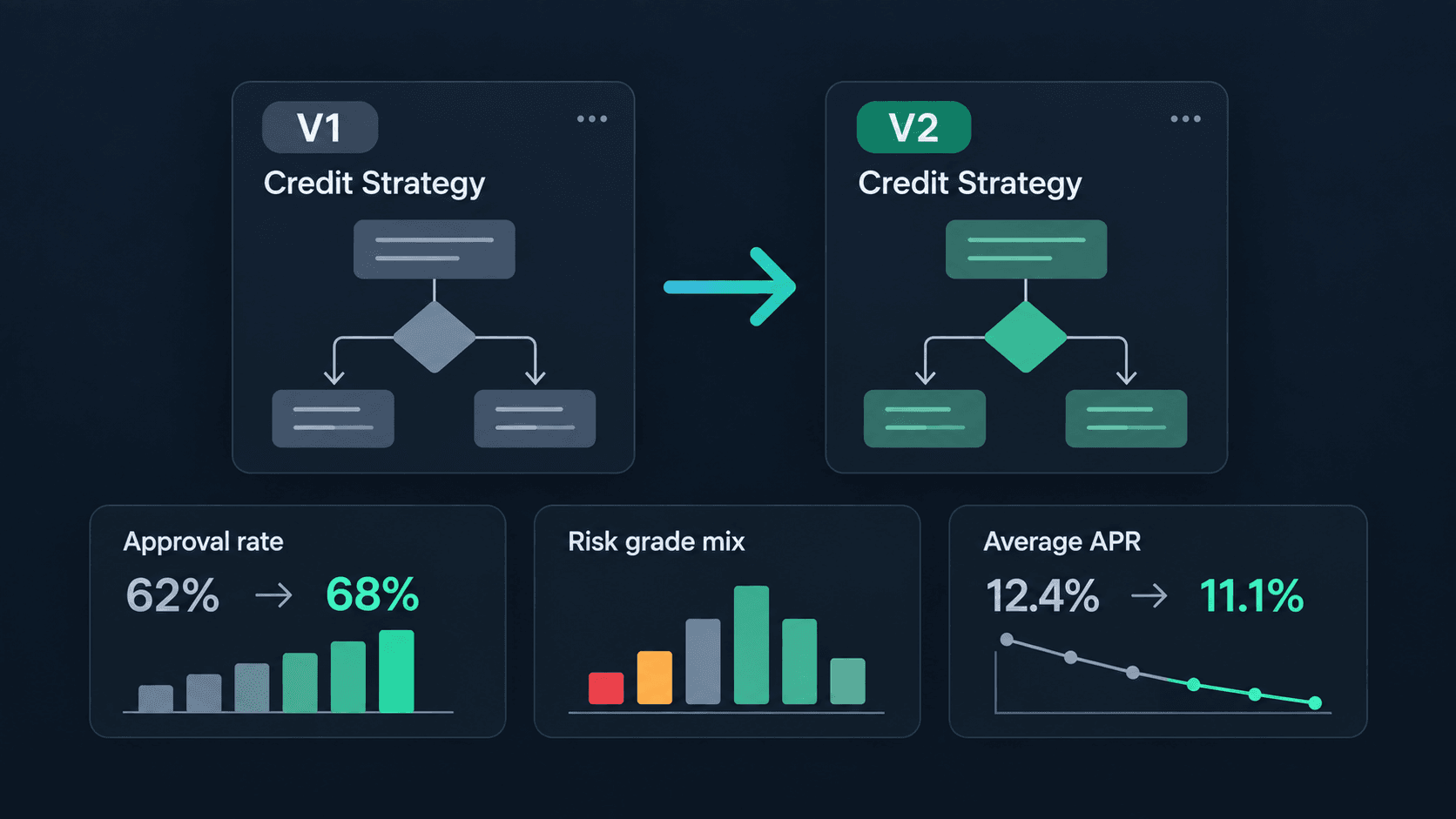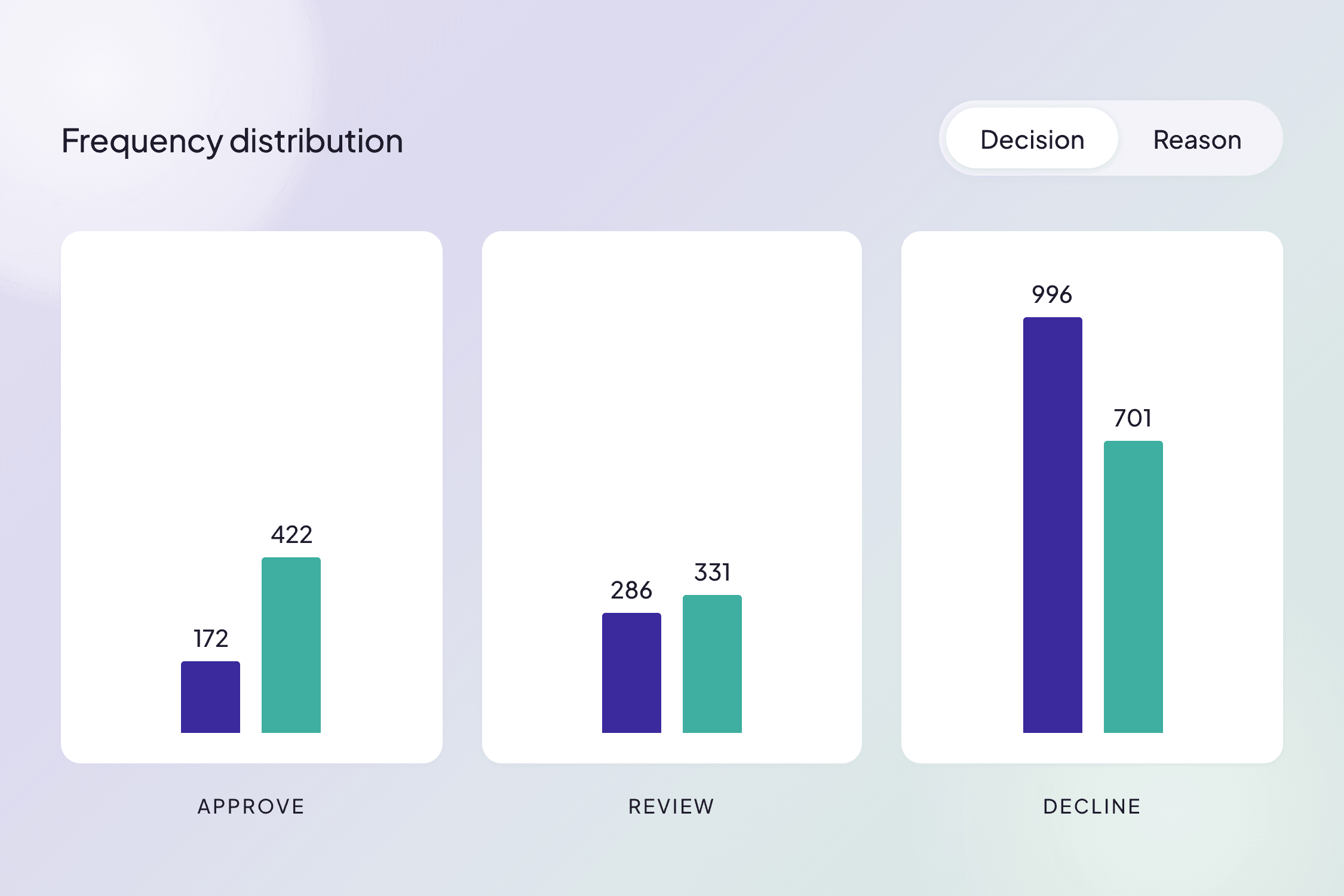
Executive Summary & Introduction
Traditional credit risk monitoring relies on lag indicators, such as early payment defaults or 30+ days past due, which take 2 to 12 months to yield actionable signals. In modern automated environments, including those using engines such as DecisionRules, risk managers can evaluate risk at the moment of decision execution to catch operational failures, population shifts, and model drift before portfolio degradation occurs.
Moving from portfolio outcome analytics to execution-time strategy monitoring requires a credit decisioning system that exposes what happens during every decision. When DecisionRules is used for credit decisioning, its in-app Decision Intelligence cockpit is where this monitoring takes place.
How Does Credit Decisioning Intelligence Work in Practice?
Consider a typical neobank that uses DecisionRules to define its credit strategies and execute scoring decisions.
Credit Scoring Process
The complex credit scoring rule, created with the Decision Flow rule type, covers eligibility criteria, score calculation, affordability evaluation, final credit limit assignment, and policy rules that route an application to approval, decline, manual approval, or an alternative limit.
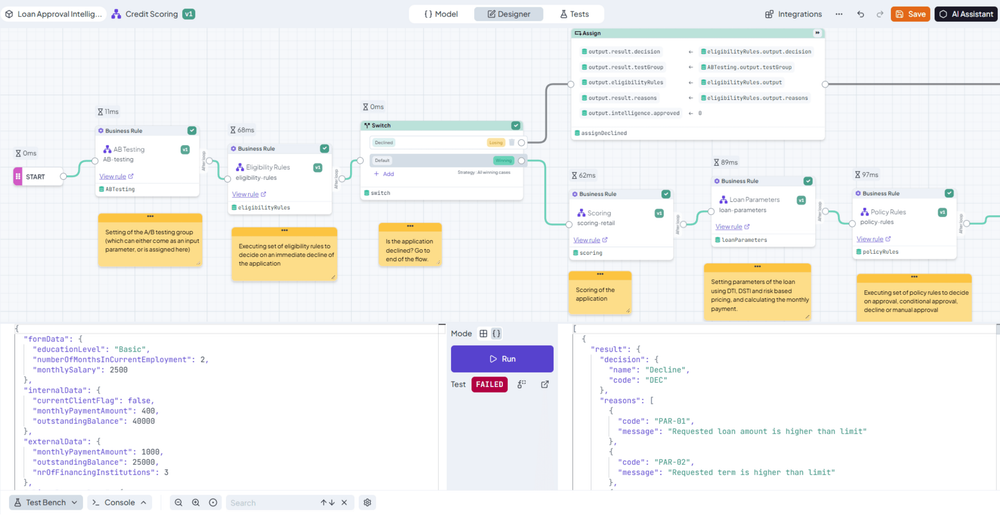
A neobank’s Credit Scoring rule producing a decision on a loan application.
This rule is executed in DecisionRules as part of the loan application process. Each execution is logged and available for online export to BI tools. The logs are also available directly in the application, where Decision Intelligence provides analytical insight into the decisions.
Decision Intelligence Cockpit
The Decision Intelligence cockpit in DecisionRules, available under Decision Intelligence → Statistics, enables users to keep rules under control directly in the application. After selecting the monitoring base, including the rule and date range, users can choose any input or output to display:
- Frequency distribution
- Evolution over time
- A list of individual calls included in the statistics
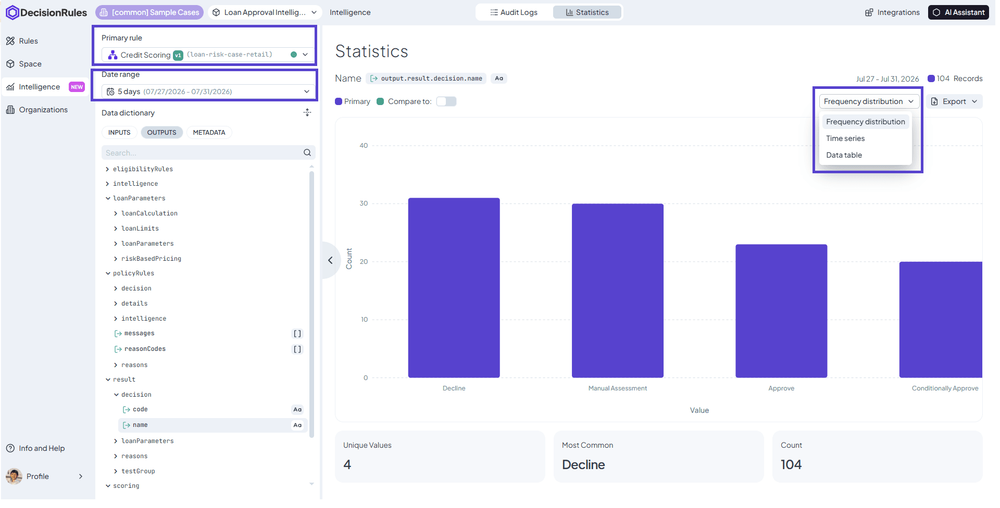
Decision Intelligence cockpit, with rule, time range, and characteristic selection on the left and the resulting charts on the right.
Users can also compare results across time ranges, such as week to week, and identify shifts. Select “Compare to,” then choose the rule, in this case the same rule under review, and the comparison period.
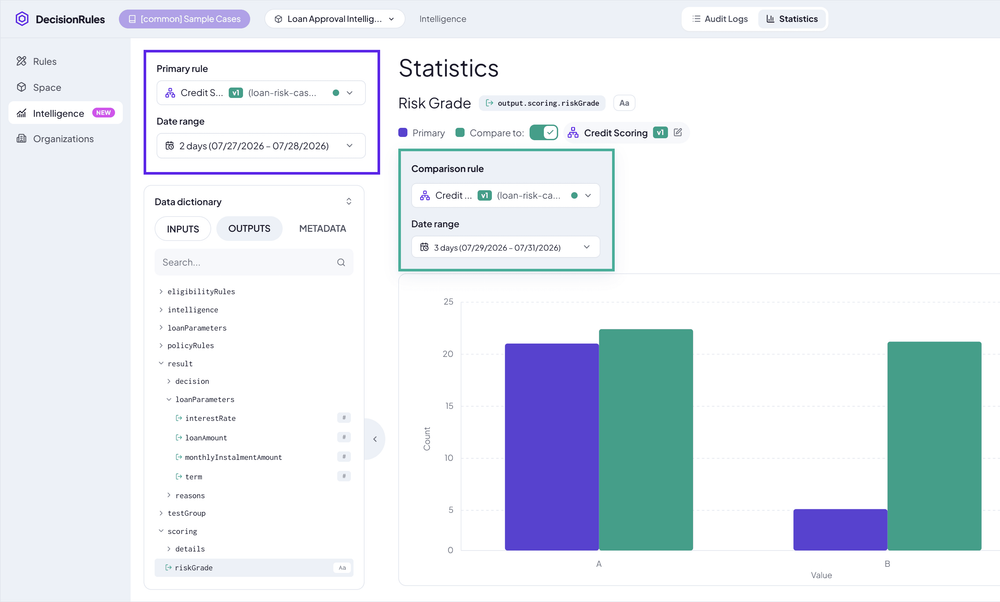
Decision Intelligence cockpit comparing characteristic values across different time ranges.
This capability is critical for Credit Scoring use cases. Credit risk cannot remain under control without close monitoring of the loan application process, its results, and the ability to examine the details.
For more details on Decision Intelligence, refer to the documentation.
How Do You Monitor the Loan Application Process?
Which metrics matter most in the credit decisioning process? The following categories show how DecisionRules Decision Intelligence can support monitoring.
Overall Flow Metrics: Approval Rate and Referral Rate
What it measures: The real-time ratio of straight approvals, outright declines, and manual review escalations, whether caused by the system being unable to decide or by a client not meeting the requested product parameters.
Why it matters at decision time: A sudden drop in approval rate, or a spike in referral rate, can signal upstream data anomalies. Examples include an external credit bureau API returning fallback values, a sudden shift in the applicant population after a marketing campaign, or an aggressive policy rule that creates a bottleneck. An unplanned increase in approval rate can likewise indicate data anomalies or rule malfunctions. Controlling approval rates protects lender income, while controlling referral rates protects operational SLA capacity.
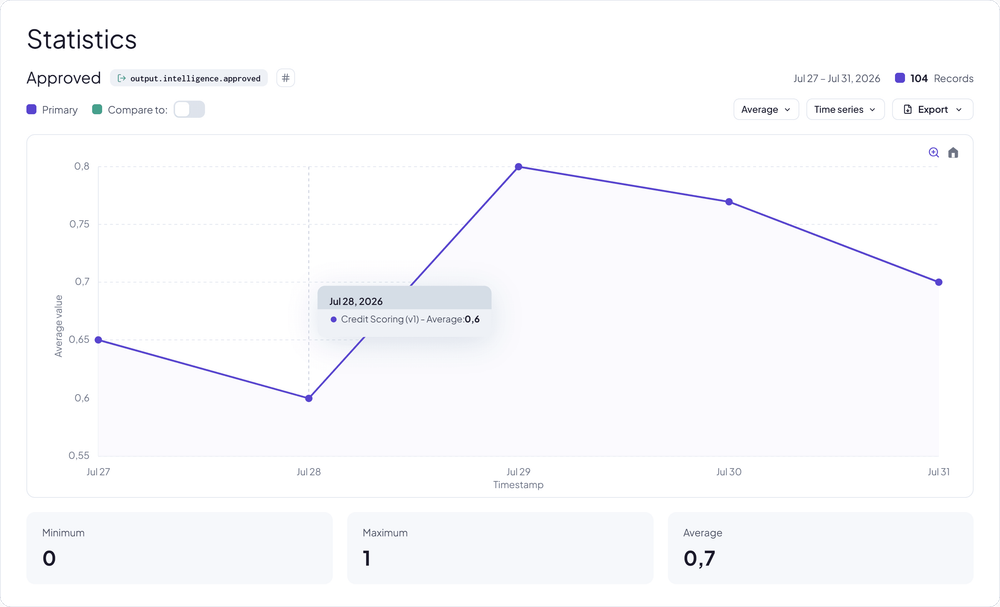
Approval rate evolution over time. Daily fluctuation is normal because the applicant mix changes. An immediate drop or surge, or a trend lasting five or more days, signals a need to investigate the details.
Approved Loan Parameters: APR & Limit Assignment
What it measures: The output distribution of APR or pricing tiers and credit line allocations mapped across risk bands.
Why it matters at decision time: This confirms that the risk engine maintains expected net interest margins and capital allocation parameters. If an unexpectedly high percentage of approvals shifts into low-margin tiers, commercial targets may miss expectations regardless of loss performance.
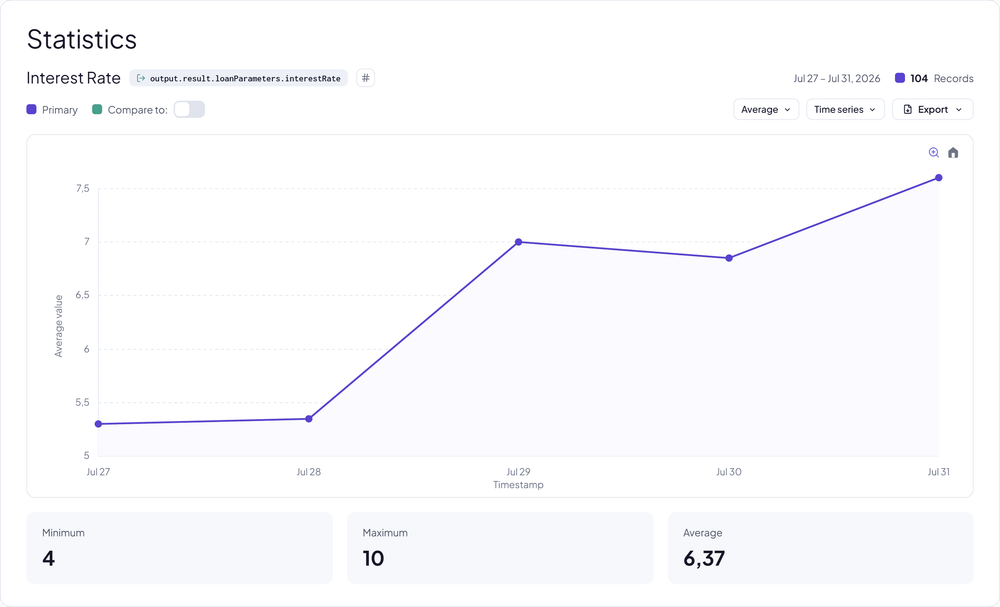
A sudden or gradual shift in the average interest rate without a change to the underlying risk-based pricing model can indicate a shift in the applicant population, risk grades, or requested loan parameters.
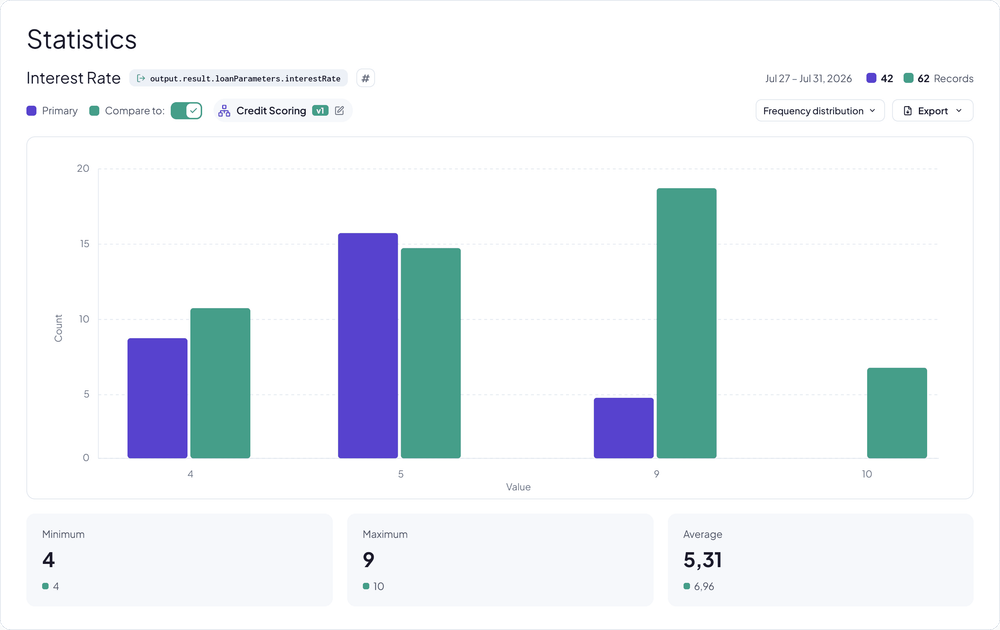
Split the observed interval into two periods and compare them. A significantly larger share at a 9% interest rate may result from a shift in risk-grade distribution or different loan parameters.
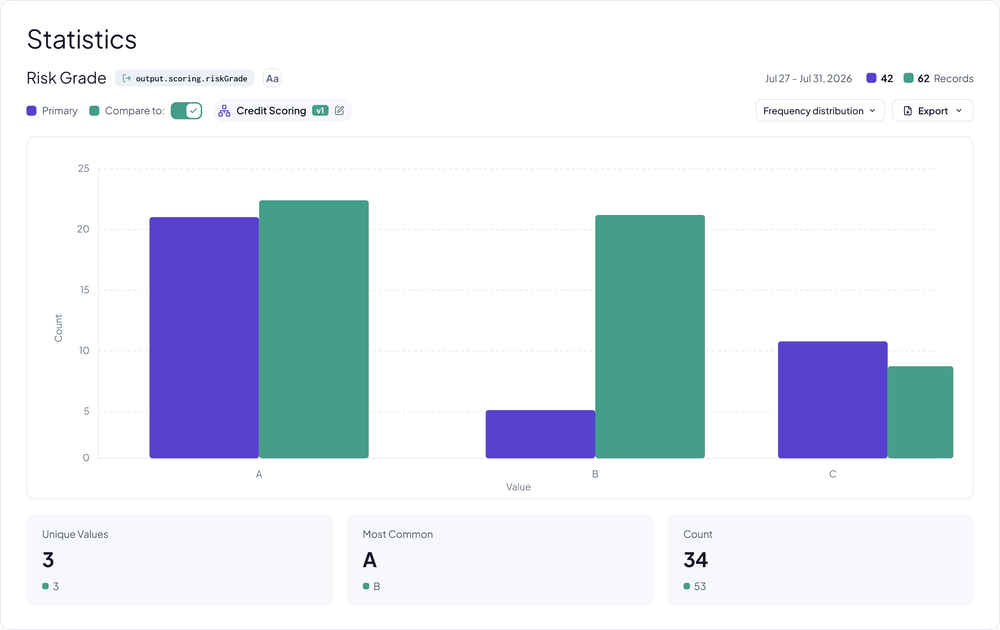
Risk-grade distribution across two time ranges on the same strategy. Small changes are natural, while larger changes without a scoring-model update may indicate population shifts, input-data problems, or scoring malfunctions.
Scoring Model and Population Stability
What it measures: Real-time distribution shifts in incoming applicant characteristics, such as income, education type, and credit bureau score, together with output scorecard values compared with baseline development populations.
Why it matters at decision time: Waiting for vintage loss curves to reveal that the applicant pool has become riskier is too late. Monitoring population stability during execution flags macroeconomic shifts, including inflationary pressure, or changes in marketing channels immediately. Strategy adjustments can then occur before bad loans originate.
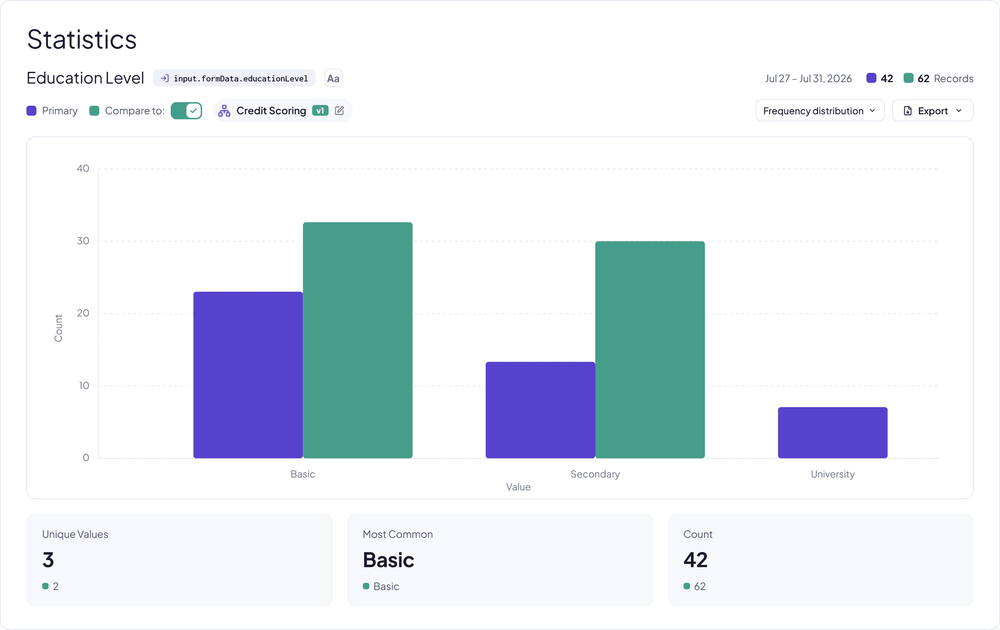
Population changes. A rapid rise in applicants with secondary education is unlikely to be natural evolution alone and may reflect a marketing campaign targeting a new client segment.
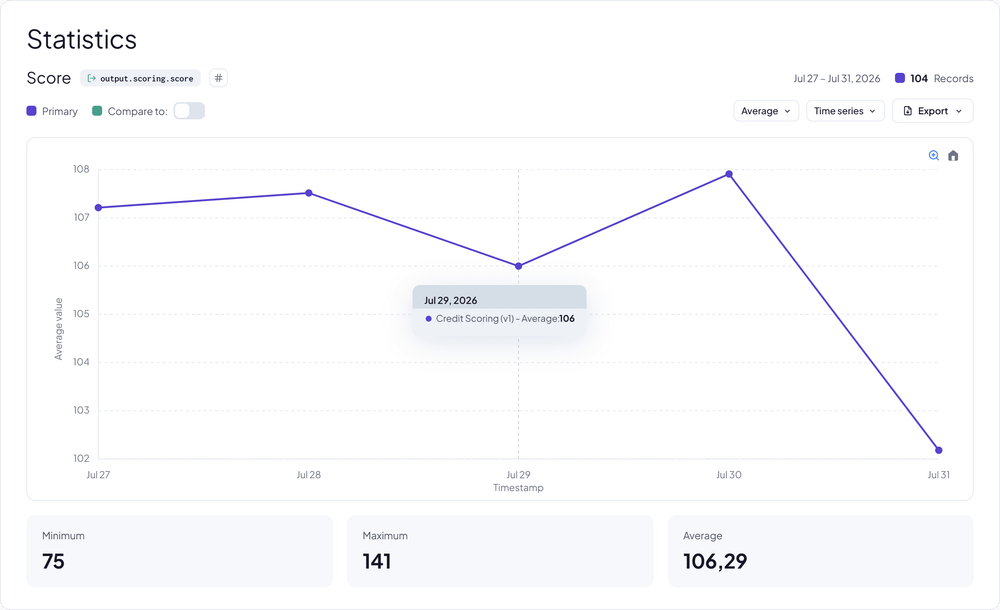
Score stability over time helps reveal population changes and their effect on approval rates or loan parameters. A significant shift may trigger a model review.
Policy Execution & Rule Efficiency
What it measures: The frequency with which individual eligibility, fraud, or policy rules trigger across incoming evaluation payloads.
Why it matters at decision time: This identifies dead rules or redundant policy logic inside a DecisionRules Decision Tree. If one policy rule accounts for 90% of declines, it removes much of the predictive value of downstream scorecards or affordability calculations.
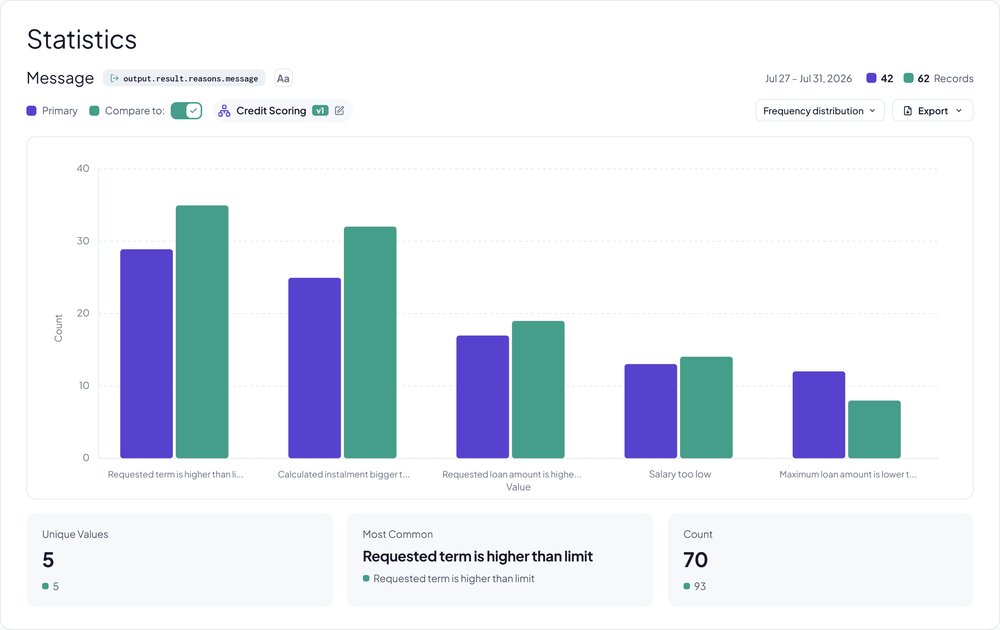
Changes in rule firing frequency across two time ranges provide granular control over individual policies and can reveal problems in the incoming population, data, or system configuration.
Conclusion
Real-time decision monitoring turns underwriting from a reactive post-mortem exercise into a dynamic, proactive control system. The ability to analyze decisions directly in the tool is a key DecisionRules advantage over comparable rules engines, giving risk users direct control over their credit decisioning strategies.
Next: See how to test and monitor the impact of a credit policy change.

Karel Svec is a Solution Consultant at DecisionRules with 20 years of experience helping businesses manage their decisioning logic and improve efficiency. For 13 years, he acted as a Team Leader and Manager of Decision Sciences / Risk Infrastructure in the banking sector, being responsible for design of the credit decisioning infrastructure, implementation of lending rules and integration to credit bureau services. Utilizing this experience, he specializes in solutions for credit decisioning, risk management and other financial use cases.