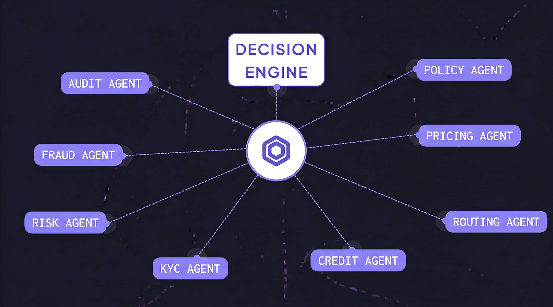
Where Deterministic Rules Hit a Wall
Every decision pipeline eventually meets an input it was not designed for. A pricing table handles structured values cleanly. A Decision Tree branches through explicit conditions without ambiguity. Both are fast, predictable, and easy to audit.
Then a document arrives that needs to be read, not matched. Hard-coded logic cannot interpret meaning, so teams fall back on manual review, which creates a bottleneck. Reaching for an AI tool outside your governance perimeter solves the reading problem but introduces a compliance one. The AI Agent was built to close that gap from inside the platform.
What Is an AI Agent?
An AI Agent is a rule type that delegates decision logic to a large language model. Instead of rows of conditions and outcomes, you describe what you want the model to do in plain language, define what the output should look like, and the model does the rest.
Every time the rule runs, it reasons over the input and returns a typed, structured JSON response that your downstream logic can act on immediately. The output is not free text. It is a defined schema your Decision Tables and Flows already know how to consume.
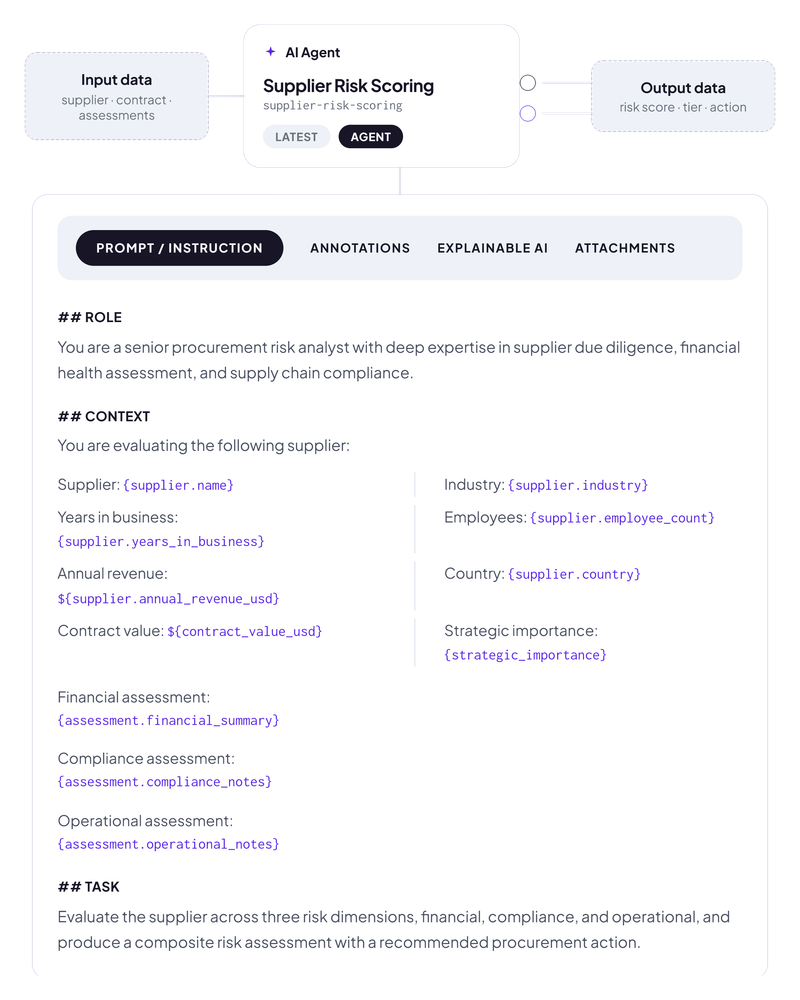
Structured prompt wires input fields into a defined task and a typed output.
When to Reach for It
The AI Agent does not compete with your other rule types. It covers the cases they were never meant to handle. The dividing line is the input: explicit values call for a Decision Table or Tree, while meaning that has to be interpreted calls for an AI Agent.
| Decision Table | Decision Tree | AI Agent | |
|---|---|---|---|
| Input type | Structured values | Structured values | Structured or unstructured |
| Logic definition | Condition/result rows | Branching conditions | Natural language prompt |
| Output | Fixed result values | Fixed result values | Typed JSON generated by LLM |
| Determinism | Fully deterministic | Fully deterministic | Probabilistic (caching available) |
| Auditability | Full row-level trace | Full branch trace | Explainable AI output (optional) |
| Best for | Tabular business rules | Hierarchical decisions | Reasoning, scoring, extraction |
The rule of thumb is simple. When your logic can be expressed fully as explicit conditions, a Decision Table or Tree will be faster and easier to audit. When the ambiguity of the input makes explicit rules impractical, that is the moment for an AI Agent.
What It Can Do?
The range of problems an AI Agent can handle is broad, but in practice nearly every use case maps to one of four patterns. Knowing which one you are building shapes how you write the prompt and define the output.

Decision Maker
Takes a set of inputs and produces a score, a classification, or a routing outcome in a single pass.
Credit pre-screening · fraud triage

Policy Validator
Checks submitted data against a defined standard and flags what fails, returning corrected values.
NDA validation · data quality checks

Report Writer
Turns complex input into a clear summary a person can act on without reading the source data.
Underwriter memos · decision summaries

Deep Analyzer
Reads a document or record and pulls out structured intelligence as clean fields for downstream rules.
Contract extraction · KYC parsing
---
If your use case spans more than one of these, the right instinct is to split it. A focused agent that does one thing reliably is far easier to configure, test, and maintain than one trying to extract, score, summarize, and validate all at once.
Built-In Features
Getting an AI Agent to perform in a real environment takes more than a good prompt. DecisionRules builds the supporting infrastructure directly into the rule type, so the parts that usually require custom engineering are already there.

Data Dictionary
A live reference of every input field, rule variable, and attached file, each draggable into the prompt editor.
No guesswork on field names or paths

Explainable AI
Adds a structured explanation to every response: a confidence score, the reasoning, sources, and warnings.
Route low-confidence outputs to review

Response Caching
When the same input reaches a rule twice in a short window, the stored result is returned without the model.
Useful for parallel branches and retries

File Attachments
Embed a policy or contract template into the agent. The model reasons against it alongside the live input.
Update the file in a new rule version
---
See It in Action: Ready-to-Use Templates
The fastest way to understand what an AI Agent can do is to see one working on a real problem. DecisionRules ships templates that you can import into your workspace immediately and start testing against your own data.
NDA Terms Validation takes a counterparty NDA submission, checks every clause against your company's minimum standards, and returns a field-by-field compliance result alongside corrected values for anything that falls short.
The final output is a clear verdict: approved, approved with conditions, or rejected. Ready to feed directly into your legal review or negotiation workflow. What used to require a lawyer reading through a document now runs in seconds and produces structured data your downstream rules can act on.
Product Return Intelligence analyzes incoming return requests end-to-end. It reads the customer description alongside order history and return policy, classifies the root cause, detects fraud signals, reads customer sentiment, and produces a recommended action with priority level and a plain-language resolution summary.
Teams handling high return volumes can route clear-cut cases to automated resolution and flag genuine edge cases for human review, without anyone manually triaging the queue.
Both templates are preconfigured with prompts, output schemas, and annotations, so the structure is already there. To activate them you just need to connect your LLM provider.
See how to set up an AI model connector in the documentation.
Fitting the AI Agent Into Your Decision Architecture
An AI Agent does not replace your deterministic rules. It extends what they can handle.
The most robust patterns combine both. An AI Agent reads an unstructured document and extracts structured fields. A Decision Table then applies explicit business logic to those fields. A Decision Flow orchestrates the sequence, handles branching on confidence scores, and routes low-confidence outputs to human review. Every component is governed, versioned, and auditable.
This is the answer to the tension regulators and compliance teams keep raising. AI-generated decisions have to be explainable and traceable, yet most AI sits outside the systems that could make them so. By bringing the model inside the same platform as your deterministic logic, DecisionRules lets the rules that must be exact stay exact and lets the AI handle only the part that genuinely needs judgment, with the same controls applied to both.
That is what makes this more than another way to call a model. The AI Agent is the first rule type that can reason over meaning, and it does so inside the place your decisions already live. The logic that must be certain stays certain. The complexity that used to force a human into the loop, or a workaround outside your governance, now has a home in the pipeline. That is the difference between adding AI to your stack and giving your decision engine the ability to think.

Ivan Peresta works at DecisionRules, where his role spans product analysis, professional services, and customer support. He is involved across the full lifecycle of product features, from early design and UX thinking to hands-on testing, documentation, and customer-facing delivery. His work bridges the gap between product development and the people who actually use it, whether that means helping a customer design their rule system or making sure a new feature ships with clear guidance and working examples.