
This article is organised around two of those pains: the operational burden of running ODM, and the vocabulary tax that keeps business users dependent on developers. Each shown as it appears in ODM and how it resolves in DecisionRules.
The patterns described are industry-agnostic; they apply whether the rules concern loan eligibility, insurance underwriting, telecom bundles, or government entitlements.
What Is a Business Rules Engine?
A business rules engine (BRE) exists for one reason: to make automated business decisions cheap, fast, and safe to change. The decisions themselves belong to the business. The BRE is what lets the business own them.
The right BRE earns its place by passing a simple test: a product manager, compliance lead, or risk officer can open it, see what is currently in production, change a threshold, and ship the change without filing a developer ticket. That is what "automation" actually means.
A BRE that creates new specialist roles, new deployment pipelines, and new infrastructure to maintain is solving the wrong problem.
Pain 1: The Infrastructure Burden
In ODM
A deployment is not a single product but a stack: an application server (WebSphere, Liberty, JBoss, WebLogic, or Tomcat), a relational database for the rule repository, Decision Center as the authoring environment, Decision Server as the runtime, multiple deployable archives, profile configurations, optional clustering for high availability, and a dedicated environment per stage.
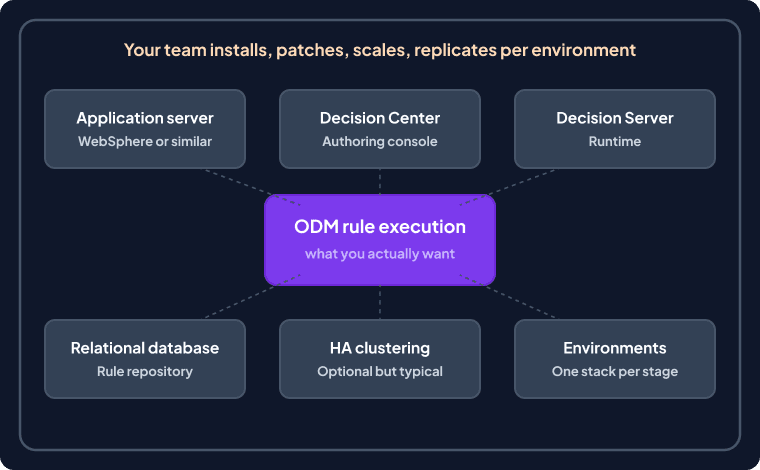
Every ODM environment carries a full stack that the team installs, patches, and replicates for each stage.
Patching, upgrading, and capacity planning all happen in-house. The required skill set covers WebSphere administration, ODM internals, and Java enterprise integration — specialised areas with their own dedicated talent market. Business users may author rules in Decision Center, but the deployment beneath them is a developer and sysadmin responsibility.
In DecisionRules
Delivered as a managed service. Public Cloud (SaaS on AWS, US or EU regions), Private Managed Cloud (a dedicated environment in a customer-chosen region, typically live within days), or Self-Hosted (a Docker or Kubernetes deployment, including air-gapped).
All three use the same UI, same APIs, same skill set.

All three deployment models share the same UI, the same APIs, and the same skill set.
For Public Cloud and Private Managed Cloud there is nothing for the customer to install, patch, or scale. DecisionRules runs the platform end to end.
Self-hosted deployments are a single container plus a MongoDB instance the team manages; the application server, separate authoring console, and per-stage stack replication still disappear.
Pain 2: The Vocabulary Tax
In ODM
Business users do not write rules in free English. They assemble rules from a controlled vocabulary developers built in advance. The chain has four layers where three of those layers sit behind a fence the business user cannot cross.
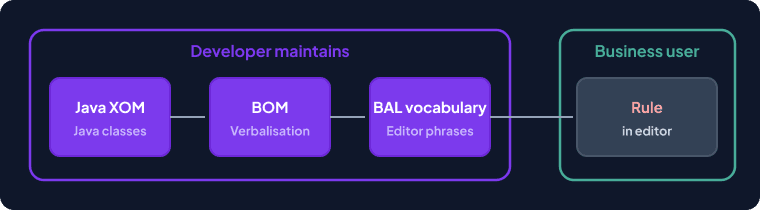
Three of the four layers sit behind a fence that only a developer can cross.
When a business user needs a concept that is not yet in the vocabulary as a new flag, a new computation, a new field a developer must extend the XOM, update the BOM, verbalize the new element, and republish before the phrase appears in the dropdown. The vocabulary itself needs ongoing curation: default verbalizations are not always business-friendly, large BOMs produce unwieldy vocabularies that slow the editor, and developers spend real time pruning with Categories and Virtual Methods.
In DecisionRules
The two-layer model collapsed. The rule's input and output schemas are the vocabulary. Schema and rule live in the same environment, edited by the same people, in the same review cycle.
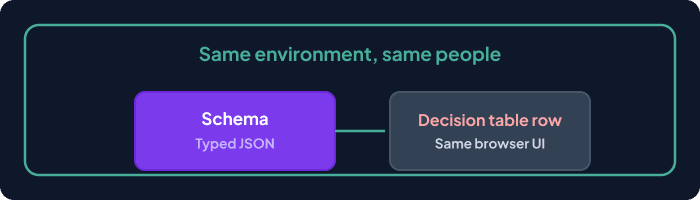
The schema and the rule live in one environment, so a new field is available the moment it exists.
A field exists in the schema and it is immediately available as a condition column or output column in the table. No separate object model, no verbalization step, no developer ticket required to surface a new variable.
A Real Example: Cumulative Bonus
Here is an actual ODM rule from a bonus-calculation rule project. The business intent fits in one sentence: when an employee has both SMART awards and SYNERGY awards, sum the SMART bonus amounts and add that total to every SYNERGY award.
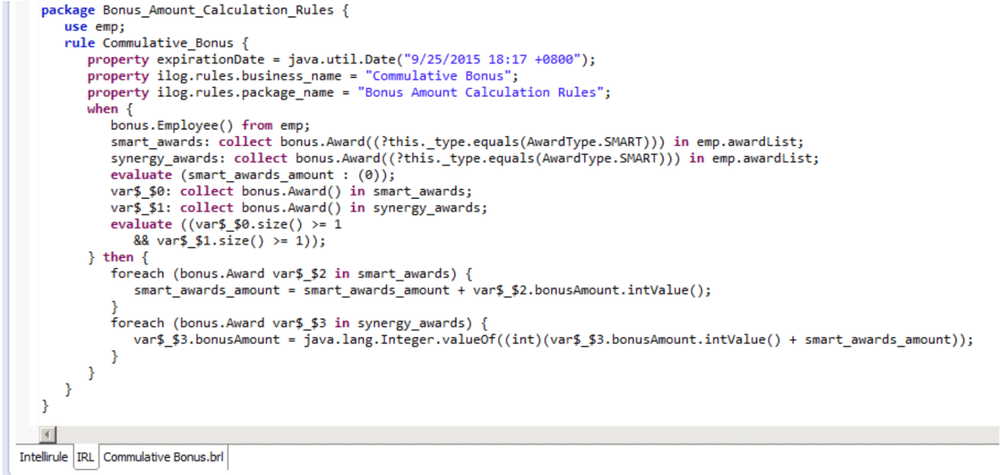
The readable English an analyst sees rests on a Java class a developer wrote in advance.
When you open this rule in the Decision Center, you do not see the code in the screenshot. You see the BAL view, readable English the analyst can edit:
for each award in smart awards do set 'smart total' to smart total + the bonus amount of the award;
for each award in synergy awards do set the bonus amount of the award to the bonus amount of the award + smart total;
Fluent. You can change a threshold, add a condition, rename a category. That part is not the problem.
What is harder is changing what the dropdown contains.
Every phrase you read in that BAL like "the bonus amount of the award", "smart awards", "synergy awards" exists in the dropdown only because a developer wrote a Java class for Award, gave it a bonusAmount field, exposed it through a Business Object Model, and wrote the English verbalization by hand. If tomorrow the business wants to add a regional bonus modifier to the rule, you cannot.
The fluency is real, but it operates within the vocabulary the developer has prepared.
The same rule in DecisionRules is yours to own
In DecisionRules, the same business intent is a Decision Flow that calls one Decision Table. Both authored in the browser. Both yours.
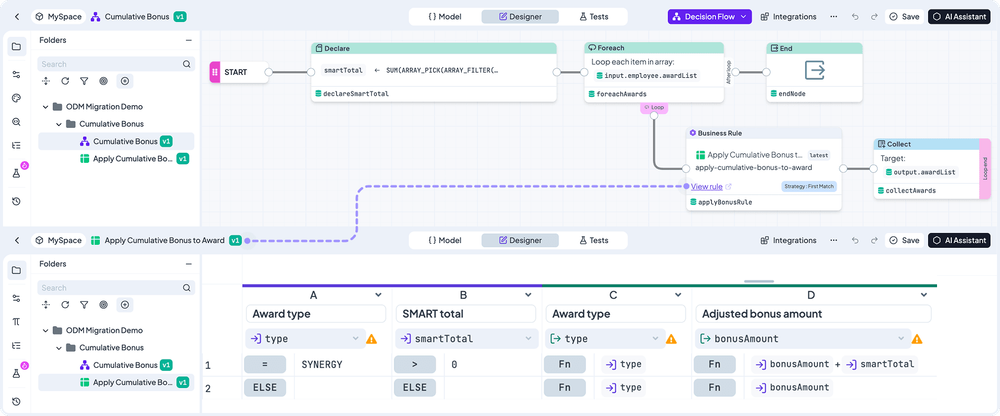
The flow makes the orchestration legible and the table holds the per-award decision, both editable in the browser.
The flow on top shows the whole algorithm at a glance: aggregate the SMART total once, walk the award list, for every award call the table below, collect the results into the output. That boundary is the moment of delegation. The flow stops handling orchestration there, and the table takes over the per-award decision.
That table is the rule's heart, and you can read what it does in one pass. SYNERGY awards get the SMART total added to their bonus, everything ELSE stays the same. Want to change the threshold from "greater than 0" to "greater than 100"? Click the cell, type the number, publish. Adding a third row for a new award type is the same: add the row, fill the cells, publish. No developer, no Java class, no ticket.
The flow above the table earns its keep by making the orchestration legible. The aggregation step is one node anyone can point at. The iteration is one node. The per-award decision is one node and that node is the table you just read. The collect node names exactly where the result goes. Nothing is hidden underneath in a generated form nobody can edit.
And the regional bonus modifier scenario, the one that gets stuck in ODM? The point is not that this rule is hard. It is that even a small rule reaches a boundary the moment you need a concept the developer did not pre-expose. In DecisionRules that wall does not exist, because the layer that builds the wall does not exist.
What maps to what: the translation
Migration is a translation, not a rewrite. ODM and DecisionRules both offer a roster of rule types and every ODM artifact you carry today has a counterpart in DecisionRules.
For most rules, the type translates one-to-one: an ODM decision table becomes a DecisionRules decision table; an ODM decision tree becomes a DecisionRules decision tree.
The picture below is not about the number of rule types. It is about what each rule type sits on, where you author it, how it runs, and what you have to maintain to keep it running. The top of the stack translates; the bottom collapses.
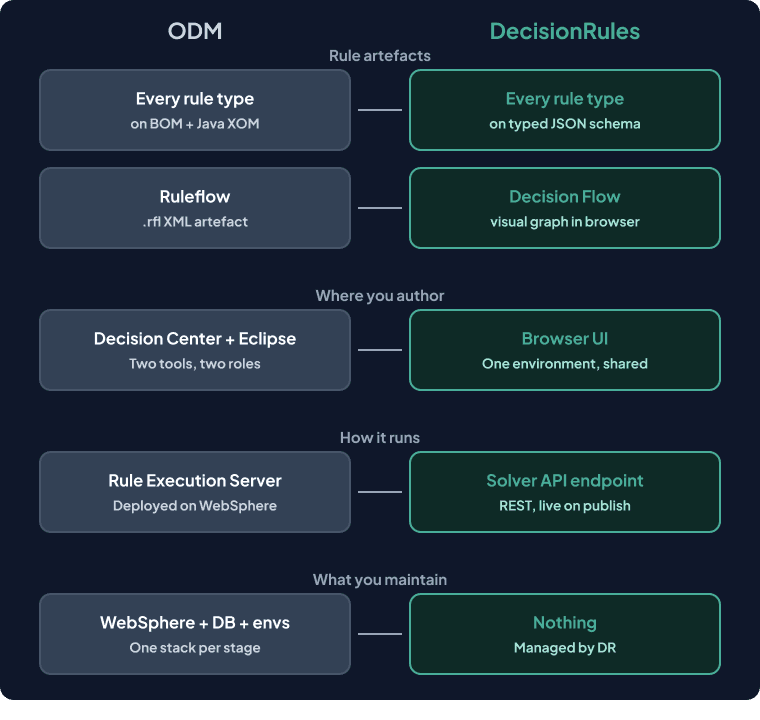
The top of the stack translates one to one and the bottom disappears entirely.
Rule artefacts
Every rule type in ODM sits on a Business Object Model that wraps a Java Execution Object Model, with each property and method verbalised by hand into the vocabulary the author sees. Every rule type in DecisionRules sits on a typed JSON schema declared in the same UI as the rule. Same business intent in both, half the layers in DecisionRules.
Separately, the orchestration artefact of ODM's Ruleflow with its .rfl XML file becomes a Decision Flow on a visual canvas.
Where you work
ODM splits authoring across two tools: business users open Decision Center in the browser, developers open Rule Designer in Eclipse. DecisionRules collapses into one browser environment where both roles work side by side on the same artefacts.
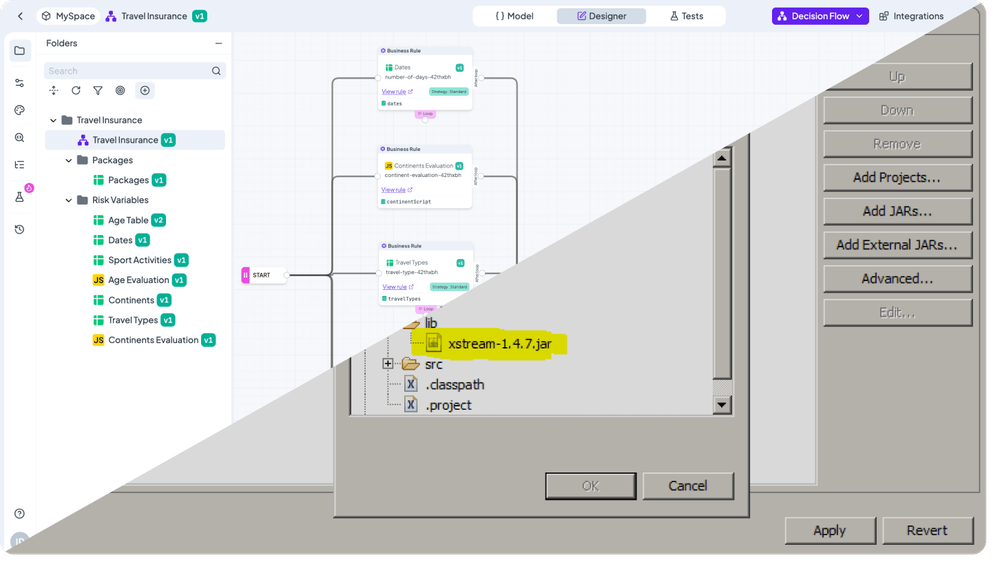
Business users and developers work on the same artefacts instead of in two separate tools.
How rules execute
Rule Execution Server lives on a WebSphere instance your team installed and patches. A DecisionRules rule, the moment you publish it, is a REST endpoint at a Solver API URL. The contract shape your application uses does not change — only the endpoint and the protocol move.
What you maintain
This is the row that collapses entirely. The WebSphere installation, the relational database holding the rule repository, the per-stage replicas for dev / SIT / UAT / production, the clustering scripts, the vocabulary pruning — all of it is gone in the managed-cloud deployments most teams pick. The picture's bottom-right "Nothing" is not a rhetorical flourish; it is the literal operational surface area you take on when you migrate.
You do not migrate alone
Read top to bottom, the picture tells the migration story in one glance. The rule logic moves across unchanged. The translation is mechanical in the top half and elimination in the bottom half and that asymmetry is what makes migration worth doing.
You do not do it alone. Our team reviews your ODM estate, agrees a migration plan with you, and then our AI Assistant, which knows the DecisionRules platform end to end, helps implement the rules quickly and consistently, reducing the manual transcription errors that a large migration would otherwise accumulate.
If you have an existing test suite from Decision Validation Services, we translate the cases alongside the rules and run them against the new DecisionRules versions, so you see equivalence before you cut over. If you do not have a test suite, the AI Assistant writes one from the rule logic itself, which gives you a regression safety net you may not have had in ODM.
What you bring to the migration is the business intent. We bring the translation and the verification.
IBM, Operational Decision Manager, ODM, WebSphere, Decision Center, Decision Server, Rule Designer, and Decision Validation Services are trademarks or registered trademarks of International Business Machines Corporation in the United States and/or other countries. All other product names mentioned are the property of their respective owners. This article is not endorsed by or affiliated with IBM Corporation.

Ivan Peresta works at DecisionRules, where his role spans product analysis, professional services, and customer support. He is involved across the full lifecycle of product features, from early design and UX thinking to hands-on testing, documentation, and customer-facing delivery. His work bridges the gap between product development and the people who actually use it, whether that means helping a customer design their rule system or making sure a new feature ships with clear guidance and working examples.