
The Wilbour Papyrus: More Than Just a Record
Around 1145 BCE, during the reign of Ramesses V, Egyptian scribes compiled what we now call the Wilbour Papyrus—one of the most important administrative documents from Ancient Egypt.
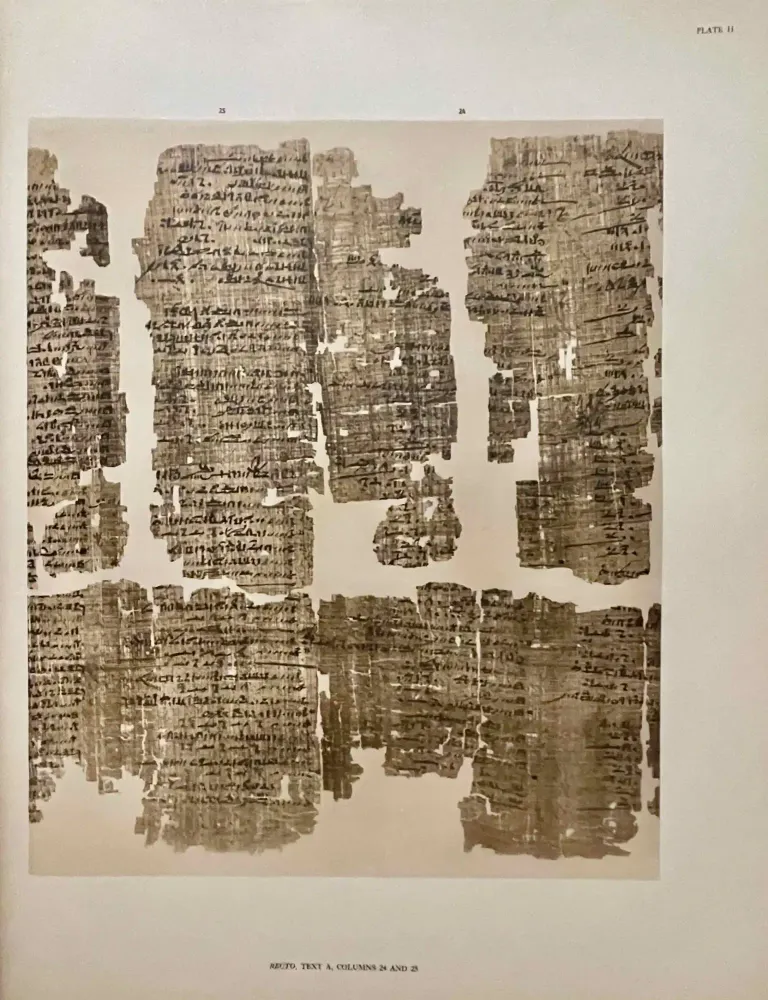
Image of The Wilbour Papyrus
The papyrus is named after the American journalist and collector Charles Edwin Wilbour, who acquired it in the 19th century; it later became part of the Brooklyn Museum collection. Physically, it is impressive: over 10 meters long, composed of multiple sheets, and densely filled with hieratic text. It contains hundreds of entries describing land holdings across a large part of Middle Egypt, including regions along the Nile floodplain.¹
What does it record?
- Land plots and their sizes (in arura)
- Categories of land (e.g. ihwty, rmnyt, m-drt)
- Holders (priests, soldiers, officials, farmers)
- Associated obligations, typically in grain
A simplified transcription inspired by published translations looks like this:
District: Middle Egypt (Text A)
| Parameter | Entry 1 | Entry 2 | Entry 3 | Entry 4 | Entry 5 |
|---|---|---|---|---|---|
| Holder | Priest of Amun | Soldier (foreign mercenary) | Stable-master | Lady (estate holder) | Farmer |
| Land type | Temple domain (rmnyt) | ihwty (small private holding) | m-drt (collective holding) | rmnyt (institutional) | ihwty |
| Area | 10 arura | 5 arura | 20 arura | 15 arura | 3 arura |
| Cultivation | Tenant farmers | ||||
| Quality | Lower yield class | ||||
| Due | 30% of yield (grain) | Reduced grain obligation | Standard institutional rate | High-yield obligation | Minimal tax / mixed obligations |
Even in this simplified form, one thing stands out: the Due field.
It is not just raw data—we see a rule applied to land type, holder, and productivity context. Egyptologists interpret the papyrus as a land survey and fiscal register, where obligations reflect standardized taxation practices tied to land classification and expected yield.¹
And that reveals something important:
The Wilbour Papyrus wasn’t just documentation. It was part of a system designed to solve a deeply human problem—how to make consistent, scalable decisions across a complex economy.
Deploying Code Without a Pipeline: The Ancient Egyptian Way
Let’s imagine a scenario. A decree is issued under Ramesses V:
“From now on, ihwty land will be taxed at a higher rate.”
What happens next?
There is no central system to update. No database migration. No deployment pipeline.
Instead, the system responds through people.
Ancient Egyptian administration was highly structured, with hierarchies of officials, regional governance, and trained scribes responsible for applying standardized procedures.² When policies changed—such as taxation levels or obligations—these changes were disseminated through administrative channels and implemented during subsequent assessments.
The new rule would be:
- Communicated through officials
- Learned and applied by scribes
- Reflected in tax assessments going forward
Records like the Wilbour Papyrus, however, would not be instantly updated. They represented a snapshot of a surveyed state, and new registers would typically be produced in later administrative cycles.¹
This is what decision update propagation looked like in Ancient Egypt:
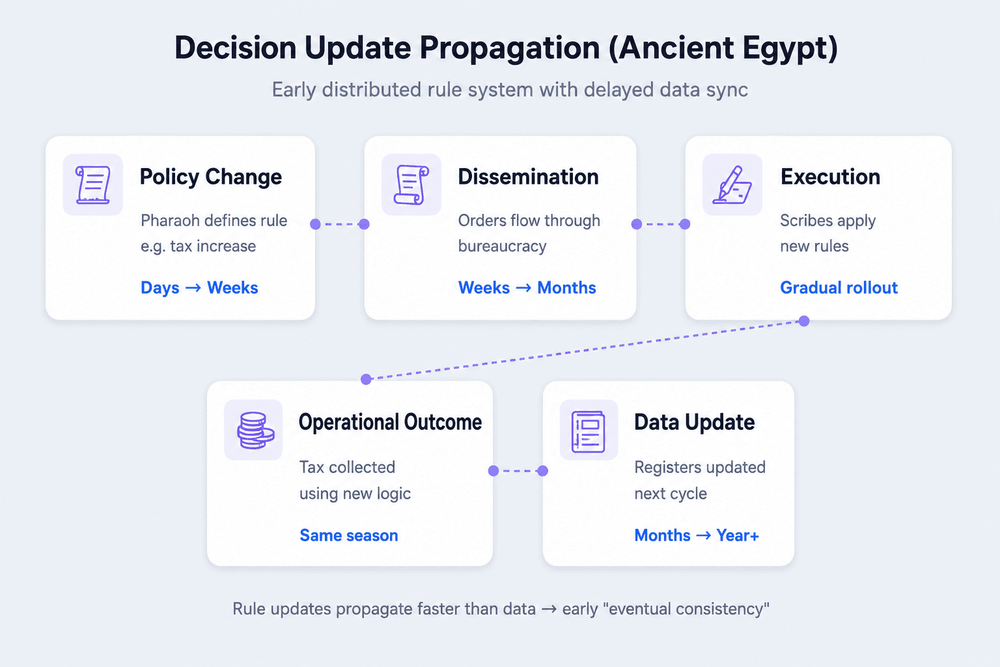
Decision update propagation process in Ancient Egypt
Two things stand out.
First, rule changes could propagate relatively quickly—within weeks or months—as soon as officials were informed. Second, the data itself lagged behind, often taking an entire administrative cycle (or longer) to fully reflect the new reality.
In other words:
The logic updated first. The data caught up later.
This aligns with how historians understand Egyptian administration: a system capable of consistent rule application, but dependent on periodic surveys and record updates rather than continuous synchronization.
Fast Forward 3,000 Years
Roughly 3,000 years later, I took an excerpt inspired by the Wilbour Papyrus and entered it into the DecisionRules AI Assistant.
Instead of a handwritten register, I got a structured Decision Table. The data is the same, but its form and application are completely different.
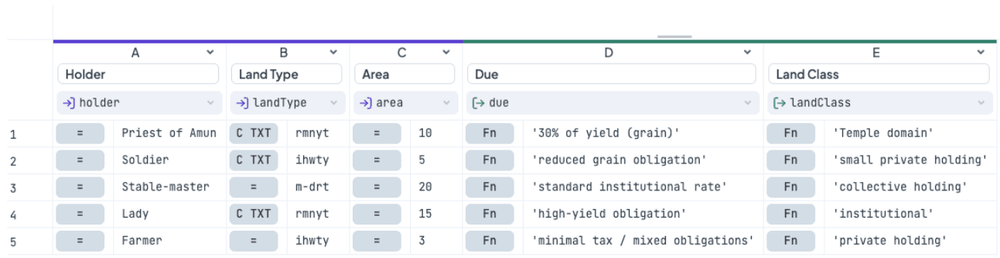
Decision Table
The transformation—from implicit institutional knowledge to explicit, executable logic—happened instantly. What once required trained scribes and administrative infrastructure now takes seconds.
To put it in simple words:
The challenges haven’t changed. Only the tools have.
Decision Update Propagation Today
Let’s revisit the same rule change in a modern system:
“Increase tax for ihwty land.”
In DecisionRules, the process looks very different.
A business user updates a Decision Table in an intuitive (at least for a modern human), spreadsheet-like interface. The change is tested immediately. Once validated, it is deployed with a single action. The updated logic is then executed in real time via API calls across all connected systems, and its impact can be monitored continuously.
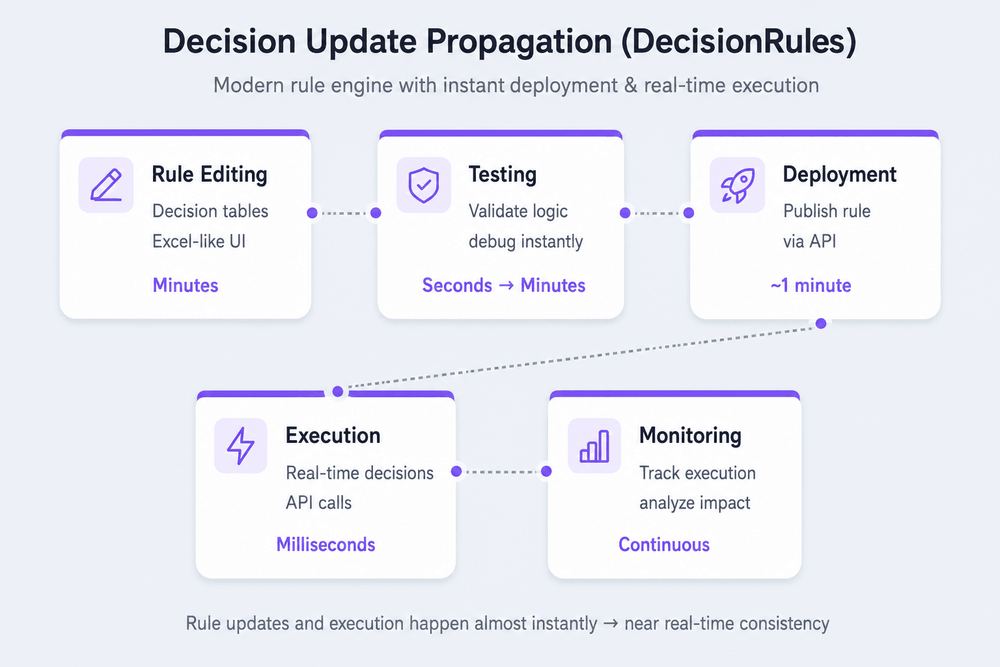
Decision Update Propagation in DecisionRules
Compared to Ancient Egypt, the contrast is striking:
Rule changes propagate instantly
Execution happens in milliseconds
Data and logic remain synchronized
What once took months now happens in near real time.
What Stayed the Same
Despite the technological leap, the underlying structure remains surprisingly familiar.
We are still solving the same core problems:
- How to define rules clearly
- How to apply them consistently
- How to scale decisions across systems
The pattern is timeless:
Inputs → Rules → Outputs
Ancient Egypt had the inputs (land, ownership, yield), the rules (institutional taxation logic), and the outputs (grain obligations). Today, we formalize and automate the same structure using rule engines.
Conclusion
Ancient Egyptians were, in the context of their time, world-class at managing complex, rule-driven systems. Their administration handled large-scale taxation, logistics, and resource allocation with a level of consistency and structure that few contemporary societies could match.
Today, we are facing the same, deeply human challenges, but we approach them with entirely different tools. We moved from papyrus to cloud applications. Decision logic is no longer embedded in institutions and executed by trained individuals—it is explicit, versioned, testable, and instantly deployable.
References
Kemp, Barry J. 2018. Ancient Egypt: Anatomy of a Civilization. 3rd ed. London: Routledge.

Jakub Kaninsky is a Lead Developer at DecisionRules, where he helps shape the development of a decision automation platform used by organizations worldwide to manage and automate business decision logic. He combines technical leadership with hands-on software engineering, contributing to product direction, feature design, architecture discussions, and the day-to-day development of the platform.