
Key Takeaway
The ERP "Core" vs. "Edge" Problem
ERPs are built for stability and transaction recording, not for the high-frequency logic changes required by modern dynamic pricing.
The Cost of Customization
Hard-coding pricing logic into ERPs creates "black boxes" that are expensive to maintain and risky to audit.
The BRE Solution
Decoupling pricing logic into a Business Rule Engine (BRE) offers a "best-of-breed" approach, keeping the ERP clean while enabling instant market adaptation.
Most Enterprise Resource Planning (ERP) systems include a core functionality - the pricing system, which provides the foundational setup for price calculation. This configuration handling standard price lists, basic tariffs, and customer master data, is essential and remains the core element of your overall pricing strategy.
However, the modern business environment demands complexity that strains these core ERP systems.
When Core Pricing Configuration Reaches its Limit
The final cost of a product or service is rarely simple; it's the result of conditional adjustments and dependencies that extend far beyond the ERP's standard configuration screens. This is where the Search Intent of business leaders shifts from administration to strategy:
- Cost-Plus Models: Calculating the final price based on the supplier cost plus a variable percentage of margin.
- Segmented Adjustments: Applying different markups or discounts based on complex criteria, such as a different wholesale price versus a retail price, or rules tied to specific customer segments.
- Conditional Context: Applying special rules based on contextual factors like specific payment terms (e.g., early payment discount) or delivery conditions (e.g., surcharge for priority shipping).
As these unique, complex, and dynamic dependencies accumulate, pricing models become highly sophisticated and complicated, often exceeding the capability of standard ERP configuration tools.
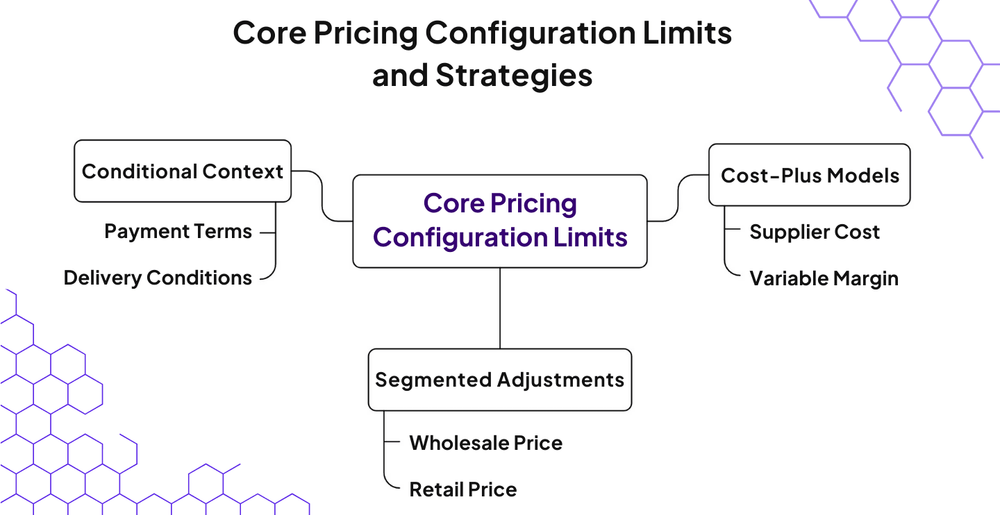
When Core Pricing Configuration Reaches its Limit
The Cost and Risk of Custom Extensions
Because core ERP/CRM systems prioritize stability and standardization, they cannot easily accommodate this high degree of dynamic, external complexity. Companies often try to bridge this gap by creating custom add-ons or extensions directly within the ERP framework.
While these add-ons solve immediate needs, they typically rely on hard-coded, proprietary "black boxes”, leading to two major pitfalls:
- High Cost and Risk: The ability to change your pricing model becomes an expensive and risky step. Every minor adjustment to a complex rule requires a specialized developer to modify code, conduct extensive testing, and redeploy the solution, slowing down business agility.
- Integration Fragmentation: The problem escalates if you have multiple software components (e.g., B2C/B2B portals, POS systems) that all need access to the same pricing logic. Managing pricing consistency across these systems becomes a complex integration nightmare.
The Problem Summary: Enhancing Core Pricing with Agility
The goal is not to replace the ERP's core pricing function, but to enrich and extend its capability with a layer of agility.
A New Dimension of Modularity with Rule Engines
The most effective solution, aligned with modern Composable Architecture, is to offload the dynamic, high-change business logic to a specialized tool, the Business Rule Engine (BRE).
This approach provides a necessary dimension of modularity by separating the core, stable ERP configuration from the complex, volatile pricing rules:
- Complementary Functionality: The ERP handles the master data, initial price lists, and the transactional framework (the core). The BRE handles the complex, conditional logic, markups, and discount sequences (the dynamic adjustments).
- Transparency and Control: The BRE provides a transparent tool where rules are defined using user-friendly interfaces (like decision tables). This empowers business analysts, not developers, to own and maintain the complex logic.
- Guaranteed Accuracy: You gain a dedicated testing and simulation tool to ensure your complex pricing logic is defined and executed correctly before affecting real transactions, significantly reducing risk.
- Integration Strength and Consistency: This single, centralized pricing service ensures powerful integration strength: because all software components in your company (whether POS, CRM, or B2B portals) call the same external BRE service, they will always result in the same final price for the same conditions. This eliminates discrepancies and guarantees pricing consistency across every sales channel.
- Auditing and Assurance: Beyond just enabling change, this separation significantly enhances transparency. The BRE automatically generates a complete record of every decision, detailing exactly which rules and data combinations were used to calculate each final price. This ensures full transparency, allowing auditors or business controllers to easily trace the logic for any transaction.
This architectural approach transforms the pricing system from a rigid, monolithic part of the ERP into an agile, centralized service. The ERP provides the solid foundation, while the BRE adds the necessary dimension of sophisticated modularity.

Jan Binko
Product Owner