
Key Takeaway
The Cost of Rigidity
Hardcoding logistics rules into ERP/WMS systems creates heavy developer bottlenecks and slows down your ability to adapt to market changes.
Precision Over Hype
While AI is powerful, carrier cost calculations require extreme precision, deterministic logic, and auditability that only a structured decision system can guarantee.
Empowering Business Teams
Adopting a flexible rule-based decision system allows logistics analysts to manage dynamic price lists and operational constraints instantly, without writing a single line of code.
The Hidden Challenges in Modern Logistics
The modern logistics ecosystem is evolving at breakneck speed. We see warehouses increasingly relying on advanced automation, Warehouse Management Systems (WMS), Sorting systems, Automated Storage and Retrieval Systems (ASRS), and even Autonomous Mobile Robots (AMR). These technologies have successfully optimized internal warehouse processes, turning the "four walls" of the warehouse into a highly efficient engine.
However, a massive gap remains. The transportation stage, particularly carrier selection and pricing calculation, remains one of the most complex and volatile areas in the logistics chain. This is where the "hidden opportunities" lie. Your operational data is a goldmine, but only if you have the tools to act on it in real-time.
Traditional implementation approaches usually embed the logic directly into enterprise systems such as ERP or WMS. While technically possible, this approach introduces several limitations that directly hit your bottom line.
The Five Horsemen of Logistics Complexity
Logistics leaders today face a constant barrage of variables that make manual management or hardcoded logic impossible to maintain:
- Carrier Proliferation: Having multiple carrier options for the same route is great for pricing but a nightmare for manual selection.
- Volatile Pricing: Carrier price lists change frequently, often faster than an IT department can update the system.
- Route-Dependent Structures: Pricing isn't just about weight, it’s about zones, tolls, and regional constraints.
- Dynamic Operational Constraints: Warehouse capacity, loading requirements, and route structures change daily.
- The Need for Experimentation: Without the ability to run A/B testing on routes and carriers, you are guessing, not optimizing.
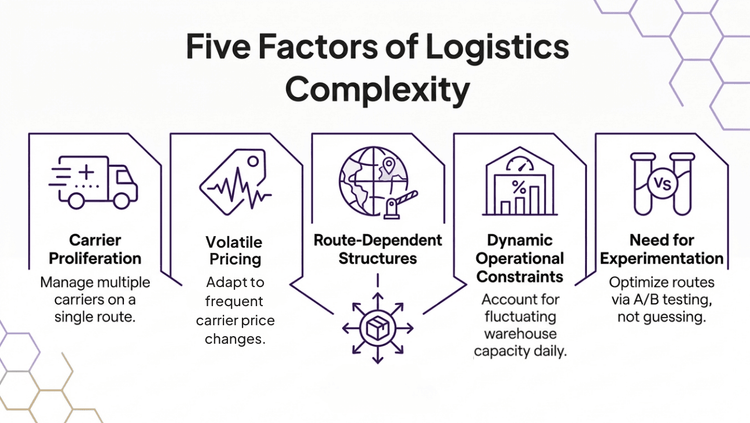
Five Factors of Logistics Complexity
The True Cost of "Rigidity" in Traditional Systems
When faced with these five complex challenges, traditional implementation approaches default to embedding the decision logic directly into the software code. In a hardcoded environment, the business logic (which carrier to use, what price applies to which zone) is tangled with the system's core architecture. This creates a cascade of inefficiencies:
- Heavy Dependency on Developers: Logistics planners cannot simply update a price list. Every adjustment requires submitting an IT ticket, pulling developers away from core product work.
- Long Development Cycles: What should be a five-minute configuration change turns into a multi-week software release cycle. By the time the new pricing is deployed, the market has already shifted.
- Limited Ability to Adjust Quickly: In logistics, even a small price difference per shipment can significantly affect overall margins. If you cannot react to a carrier's temporary surcharge instantly, you absorb that cost.
- Difficulty Executing Experiments: Want to run an A/B test on two different mid-mile carriers? In a rigid system, this type of operational experimentation is nearly impossible without massive IT overhead.
- High Maintenance Costs: Maintaining complex, hardcoded routing logic drains your IT budget and creates a brittle system where one small code change can break another routing rule.
Given that logistics is a game of margins, this rigidity creates a massive competitive disadvantage. You are forced to operate reactively rather than proactively.
Precision vs. AI-Assisted Risk in Cost Calculations
As the industry looks for solutions to this developer bottleneck, many leaders are turning to modern development tools, including AI-assisted coding or agentic development, to accelerate implementation.
While AI is excellent for generating boilerplate code, it is the wrong tool for core logistics logic. Carrier cost calculations require extreme precision, deterministic logic, versioning , and strict auditability. If an invoice is disputed, you must be able to prove exactly how a cost was calculated at a specific millisecond in time.
Frequent code changes or AI-generated logic may introduce unpredictable challenges or compliance risks. You cannot afford a "hallucination" when calculating freight costs for thousands of daily shipments.
Therefore, a more appropriate approach is the adoption of a flexible rule-based decision system that separates business logic from system code.
But how does such a system actually work in a real logistics environment?
In the next part, we will explore how a rule engine can structure carrier selection, route segmentation, and cost calculation into a transparent decision flow that allows logistics teams to adapt their operations without constant development cycles.
Continue to Part 2: Designing a Rule-Driven Logistics Calculation System - dodat link

Milan Havelka
Advisor